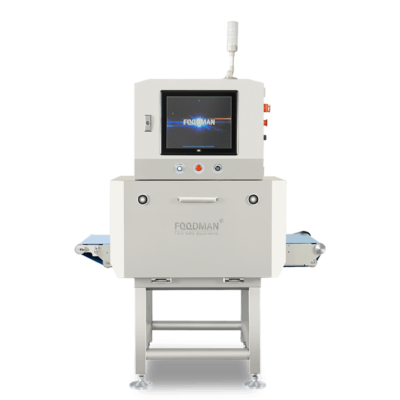
Packaged food creates a specific inspection challenge: the product is already sealed, so contamination inside the package cannot be checked without opening it. An X-ray machine provides a non-invasive way to inspect sealed products during production. By producing images from differences in material density, the system can identify foreign objects that may remain invisible from the outside.
The system must interpret the image consistently, distinguish contamination from normal product structures, and trigger the correct production response.
Why X-Ray Inspection Works Through Sealed Packaging
Unlike optical inspection, X-ray inspection does not depend on seeing the product surface. X-rays pass through the package and food, while materials with different densities absorb the radiation differently. A detector captures the resulting pattern and converts it into an image for analysis.
This principle makes the technology suitable for many packaged formats, including sachets and larger products. The referenced packaged-product range includes dedicated systems for small, medium, and large packages, showing how equipment configuration can be matched to package dimensions.
Packaging therefore does not automatically prevent inspection. The important factor is the contrast between the food, packaging, and potential contaminant. Image processing then helps determine whether an unusual dense region should be treated as a foreign object.
What the Detector Sees Inside the Package
Once a package enters the inspection tunnel, the X-ray source generates radiation across the inspection area. A detector receives the radiation that passes through the product. Variations in absorption create an image in which denser materials appear differently from surrounding food.
An X-ray machine can identify several foreign materials. The referenced packaged-product systems are designed to detect metals, glass, stones, hard plastics, and bones. Such capability is useful when contamination risks extend beyond metallic fragments.
Image capture is only the first stage. Software analyzes patterns that differ from expected product characteristics. The referenced technology uses high-resolution imaging, advanced algorithms, and AI-based approaches.
How the System Turns an Image Into a Reject Decision
A usable inspection image must become a production decision. Analysis software evaluates the image and searches for characteristics that differ from normal product patterns. If the detected signal meets the programmed criteria for a foreign object, the package can be marked for rejection.
Timing matters on a moving line. A contaminated package must be associated with the correct detection event so the appropriate unit is removed rather than a neighboring product.
Product presentation also affects analysis. Packages should move consistently through the inspection area so the system receives predictable images. Changes in orientation, spacing, or product distribution can alter the image and make inspection more demanding.
Which Packaged Foods Can Be Inspected?
The technology is not limited to one food category. The referenced system range covers packaged applications involving snacks, meat and poultry, seafood, cheese, dairy, fruits, and vegetables. Listed examples include chips, nuts, beef, chicken, shrimp, yogurt, and packaged fruit products.
Different foods create different imaging conditions. Dense meat can produce a different image from a light snack, while irregular ingredients may add visual variation. Package size also changes the amount of material that X-rays must penetrate.
Foodman views inspection as part of the wider production workflow rather than an isolated machine function. Product characteristics, package dimensions, conveyor movement, and inspection objectives need to work together if the final decision is to remain consistent.
Where X-Ray Inspection Goes Beyond Metal Detection
Metal detectors remain useful for metallic contamination, but their detection principle is different. X-ray inspection works from material-density differences and can address a wider range of foreign objects, including glass, stones, certain hard plastics, and bones. The packaged-product reference specifically identifies these materials as inspection targets.
That distinction matters when contamination risks extend beyond metal. A sealed product can be inspected without opening the package, preserving normal production while adding an internal inspection stage.
The broader range also includes specialized systems for bone detection and other food inspection tasks.
What Makes Packaged Inspection Reliable?
Reliable inspection depends on controlled conditions. The system should be calibrated and validated regularly, while products should be presented consistently. The referenced manufacturer notes that modern systems may include self-calibration, automatic sensitivity adjustment, and intelligent image optimization.
Production teams should define reject criteria and verify that the rejection mechanism responds correctly. Testing should reflect actual products and contamination risks.
Foodman supports the automation perspective by considering controlled material flow alongside inspection and weighing processes. In production, inspection accuracy has limited practical value if packages are poorly positioned or downstream handling cannot act on the result.
Choosing the Right Inspection Approach
The right system begins with the product, package, and contamination risk rather than with a machine label. Package dimensions determine the required inspection format, while product composition influences image characteristics. Production speed and presentation then affect how the inspection point should be integrated.
Foodman Vision’s packaged-product range illustrates this segmentation through systems intended for small, medium, and large packages. Foodman Vision can help place inspection within a broader automated workflow where conveying, weighing, sorting, and quality control need to operate together.
Ultimately, an X-ray machine works by turning differences in X-ray absorption into analyzable images and using image-processing logic to identify abnormal objects inside sealed products.
Its effectiveness comes from coordinating imaging, software analysis, product handling, and rejection. For packaged-food manufacturers, understanding this complete chain is essential when building a dependable inspection process.
