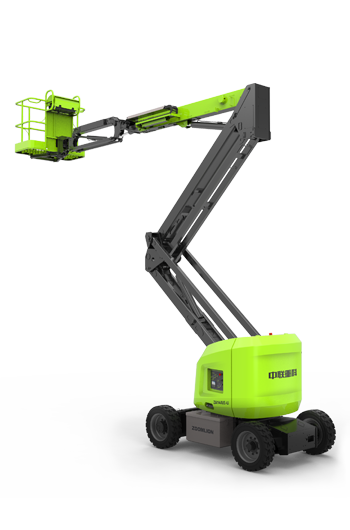
Working at height becomes more complicated when the target is not directly above the machine. An articulating boom lift can combine vertical elevation with horizontal outreach and an up-and-over path, allowing crews to position a platform beyond beams, roof edges, machinery, façades, or other fixed structures. This makes boom configuration important where straight vertical lifting cannot provide a clear approach.
Why Up-and-Over Access Matters
A vertically travelling platform is effective when the work area is located directly above a suitable setup position. Structural obstacles change that geometry. Steelwork, pipe racks, parapets, canopies, tanks, and building projections can block a direct route, forcing crews to reposition equipment or use a machine with a different reach profile.
An articulating boom uses multiple boom sections and joints to create a curved path toward the work area. Instead of relying only on maximum horizontal reach, operators can raise the boom, articulate the jib or upper section, and position the platform over or around an obstacle. IPAF’s MEWP selection guidance specifically identifies articulating booms for tasks that require work up and over an obstacle.
Think Beyond Maximum Working Height
Maximum working height tells only part of the story. For obstacle-rich projects, buyers should also examine horizontal outreach, up-and-over height, platform capacity, turning radius, machine width, and platform rotation. These dimensions determine whether the machine can reach the work point from a practical setup location.
The required route should be considered before equipment arrives. OSHA recommends inspecting the work area for overhead obstructions, inadequate clearances, electrical lines, uneven surfaces, and other hazards, while HSE guidance emphasizes selecting the right MEWP for the job and site. The objective is to match machine geometry with the access challenge rather than choosing by height alone.
Applications Around Structural Obstacles
Building maintenance often involves façades, roof-mounted equipment, atriums, signs, and service installations that sit behind or beyond fixed structures. Construction and industrial projects can introduce similar challenges around steel frames, pipe bridges, machinery, and elevated work areas. In these cases, an up-and-over route can reduce the need to place the machine directly beneath the task.
The same principle applies when the work area changes across a project. Instead of repeatedly relocating the base to achieve a straight approach, a suitable boom configuration can allow the platform to approach several positions from one carefully selected setup area. This can help where ground access is restricted, although every move still requires assessment of clearance, stability, and surrounding activity.
Operator Planning Near Obstacles
Up-and-over reach does not remove the risks associated with working close to structures. HSE identifies entrapment between the basket and fixed structures as a key MEWP hazard, while IPAF advises operators to identify overhead obstructions, plan the route, use deliberate control movements, and ensure a valid rescue plan is in place.
Worksite planning should therefore include the boom path, not only the final platform position. Teams should identify beams, cables, ceilings, pipework, traffic routes, and other pinch points before lifting. Operators should be trained for the specific MEWP category and familiarized with the machine being used, with site controls and manufacturer instructions incorporated into the work plan. OSHA likewise requires trained and authorized operators and appropriate work-area inspections.
How to Compare Articulating Boom Lift Manufacturers
For procurement teams comparing articulating boom lift manufacturers, specification depth is especially important. A brochure that lists working height but omits outreach or up-and-over dimensions does not provide enough information for obstacle-sensitive applications. Buyers should request a complete specification set and compare the machine against actual site drawings and access routes.
They should also examine platform capacity, drive speed, gradeability, turning radius, power system, tire configuration, allowable working slope, and wind limits. Certification, training resources, inspection requirements, parts availability, and service coverage can also affect fleet planning. A machine should be evaluated as a complete access solution rather than as a single reach figure.
The ZA14NJE-Li from Zoomlion Access
The ZA14NJE-Li from Zoomlion Access is an electric articulating boom lift specified for a 16 m maximum working height and 14 m platform height. Its published specifications include 8.14 m horizontal outreach and 7.74 m up-and-over height, giving buyers concrete dimensions to compare with structural layouts and work positions. Platform capacity is 230 kg and gross weight is 6,700 kg.
The machine’s specifications also list a 1.75 m stowed width, 2 m stowed height, 0.76 m platform width, 3.15 m outside turning radius, ±90° platform rotation, and 360° non-continuous turntable swing. Its 48V/315Ah lithium-ion battery, 48V/60A charger, and AC drive system are specified on the product page.
Why Zoomlion Access Can Be Considered
Zoomlion Access describes itself as a global access-equipment manufacturer and lists articulating boom lifts alongside scissor lifts, telescopic boom lifts, telehandlers, spider lifts, vertical mast lifts, vehicle-mounted boom lifts, and forklifts. Its articulating boom range includes electric, diesel, RT electric, and extended-range hybrid models, allowing buyers to compare powertrain options against application requirements.
For projects where obstacles shape the access route, articulating boom lift selection should begin with geometry: where the machine can stand, where the boom can travel, and where the platform must finally work. The ZA14NJE-Li provides published up-and-over and outreach specifications for this evaluation, while Zoomlion Access offers a broader equipment range for different site conditions and working heights.
