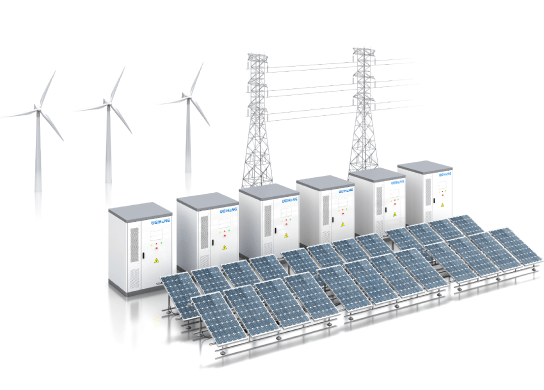
WHES develops industrial and commercial energy storage solutions designed to enhance efficiency, stability, and intelligent control in modern power networks, where energy management systems play a central role in coordinating supply, storage, and consumption alongside advanced AI energy management for optimized ESS battery operation.
AI Optimization in Energy Management Systems
Modern energy management systems rely on continuous data streams from grids, loads, and renewable sources, while AI energy management processes this information to dynamically adjust ESS battery charging and discharging in response to real-time conditions.
Instead of fixed schedules, AI energy management enables predictive control that evaluates electricity prices, demand fluctuations, and solar generation patterns to determine the most efficient dispatch strategy for each ESS battery.
This adaptive approach reduces energy waste and improves system responsiveness, particularly in commercial environments where load profiles change frequently throughout the day.
WHES OS for Intelligent Battery Dispatch
WHES OS serves as the digital intelligence layer within energy management systems, integrating AI energy management algorithms to coordinate multiple energy sources and ensure efficient ESS battery utilization across different operating scenarios.
The platform continuously monitors operational data such as state of charge, temperature, and power flow, allowing each ESS battery to be dispatched based on real-time system conditions rather than predefined rules.
By combining forecasting models with live system feedback, WHES OS improves energy scheduling accuracy and supports more stable performance in complex commercial energy environments.
Commercial Benefits of AI-Driven Energy Control
In industrial applications, energy management systems enhanced by AI energy management help reduce peak demand charges, improve renewable energy utilization, and extend the operational efficiency of each ESS battery through optimized cycling strategies.
WHES applies this approach to multi-site energy deployments, enabling centralized monitoring and coordinated dispatch across distributed ESS battery installations for greater operational consistency.
This intelligent control structure allows enterprises to shift from manual energy scheduling to automated optimization, where AI energy management continuously refines performance based on real-time system behavior and evolving energy conditions.
