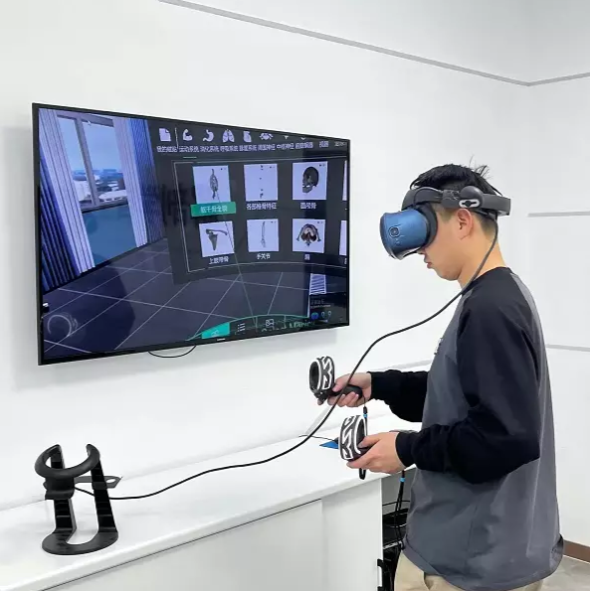
Understanding anatomy through virtual reality has become increasingly valuable for medical education. The DIGIHUMAN team offers a digital solution that aligns with modern teaching needs while staying close to real anatomical structures. Their approach integrates advanced visualization with practical teaching functions, making human anatomy VR a useful tool for schools and training centers seeking more interactive learning. At the same time, the system allows learners to observe structures in three dimensions without relying on traditional resources.
Immersive Features of the VR Anatomy System
The Digihuman VR Anatomy Teaching System is part of the broader Digihuman Anatomy System designed for professional educational environments. As the only VR product based on full 3D reconstruction, it brings high-clarity anatomical models into an immersive classroom. This human anatomy VR system includes eight major functional modules: wizard, multimedia, graphics and image, voice, puzzle, practices, UI, and interactive systems. These components work together to support different learning styles, helping students understand spatial relationships that may be difficult to visualize in textbooks. They provide an environment where users interact freely with anatomical structures, improving retention through active participation. The VR hardware—Vive glasses, VR headset, and hand controllers—ensures that the visual and operational experience remains smooth and intuitive.
Why Medical Institutions Adopt VR-Based Anatomy Tools
Many medical schools and training organizations are searching for solutions that reduce the limitations of traditional teaching materials. VR helps fill this gap by offering consistent access to complex structures without ethical concerns or challenges related to specimen preparation. Educators value systems that support discussions, demonstrations, and collaborative sessions. Here, DIGIHUMAN provides a platform suitable for medical institutions, science venues, and classrooms seeking modernized, flexible resources. Their Digihuman 3D anatomy VR system is often described by users as more engaging and enjoyable than standard tools, particularly when exploring relationships between organs and structures.
Conclusion: Enhancing Learning with VR Anatomy Education
As digital learning continues to expand, DIGIHUMAN contributes practical tools that support interactive and structured teaching. The integration of VR into anatomy courses gives students more freedom to explore details and understand complex concepts. With the help of the human anatomy VR system, institutions can upgrade their teaching methods and offer learners a more dynamic, self-directed environment.
